Blog for HIST 336E CSUSM
Extra Credit Blog #7 Dropping the Bomb
After watching the lecture and reading the articles about victims of the bombings of Hiroshima and Nagasaki I would tell President Truman to not drop the bomb. While Truman wanted to use the bomb to quickly get a surrender from Japan and showcase the power of the U.S to the USSR, the effects of the bomb are not worth it. From the articles given for week 16 it is shocking to read about the survivors and the struggles they faced due to radiation poisoning. Scientists warned the President about the radiation fallout as an effect of the bomb which makes it very dangerous. Reading about the people that were affected by the radiation poisoning years after the bombings puts aside wanting to win a war faster. Truman did have the option to pursue peace talks with the Japanese but while it would not be an unconditional surrender as he wanted it could have ended the war. This stubbornness to fully subdue the Japanese in submission cost the lives of thousands of Japanese civilians. But I feel that Truman would respond to me advising him not to use the bomb with “we’re going to save American lives with the bomb.” And that brings out the ugly reality of war, we value the lives of those on our side and would rather have the other side suffer heavy losses than us. While Truman believes that dropping the bomb will benefit the American people by ending the war quickly. I would advise him that while it may benefit the US in the short term to end the war, after the war the U.S is going to be a dominant power in the world and it must not rely on horrible weapons to influence other countries. I would advise Truman against dropping the atomic bomb as we fought this war to prove that we stood up for just reasons and by dropping the bomb on mainly civilians would disprove why we are fighting in the war.
Extra Credit Blog #5 WWII Poster
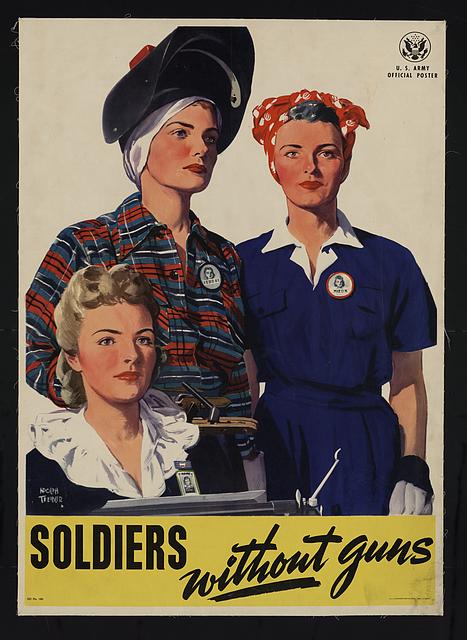
The World War 2 poster I chose to analyze was this one presenting three women and a caption that reads “Soldiers without guns.” Looking at this poster it is directed towards women as it suggests that they do not need to take combat roles to do their part for the war effort. I think the message that this poster is conveying is that women who do their part in the war effort whether it be in the defense industries or as a clerical worker in the army, that these women are strong and doing a vital service to country like men serving in the military. The use of the word “soldier” certainly is meant to empower woman to join the war effort. While it does show one woman which appears to be a clerical worker she is sitting down while the two-woman standing are obviously in the defense industries. So, by having these two defense industry women standing it highlights that women are going to be in roles that wouldn’t necessarily be a place of employment for women in peacetime. So, this poster is straying away from the gender expectations of the time by empowering women to view themselves as soldiers and that they will most likely be in jobs that would have been a “man’s” job. But I feel that the caption, “soldiers without guns” does imply gender roles as it suggests that women can’t go off and fight and use weapons, that that’s the “man’s job.” It implies that a woman should not be allowed to use a gun that her help will be by supporting through building war supplies or clerical work. This poster has little words, but the image of the women is what empowers the viewer especially female viewers to feel empowered and join the war effort. All three women are staring off into the distance with determined faces, ready for the challenges that lie ahead. The women appear to show no emotions of worry but appear strong, resilient like soldiers ready to serve their country.
Blog #6 George Takei’s Book
After reading George Takei’s graphic novel about his experience in the internment camps during WWII, I could say his main messages deal with the is the power of democracy and the personal affects against people affected in situations like this. Takei’s book does a good job of making the reader feel the emotions of what he and his family felt throughout their internment. It’s one thing to read the executive order and see pictures of the camps but Takei’s personal story takes a stronger hold on the reality of the situation about how badly these people were affected by this decision. That is what I consider to be a strength of reading a non-fiction graphic novel is that along with the illustrations it provides an image to the reader to imagine what it must have been like and the emotions behind them. Throughout the graphic novel Takei is telling his story and the feelings he felt as a boy but the story includes his thoughts in the camp and later in life about what his parents’ feelings were. The images that went along with story were a strength to using a graphic novel as it helps the reader picture events. The other message the book tells is about democracy, how it has its faults but it is a great system. Throughout the book Takei mentions democracy and how it related to his time in the camp. In the book Takei mentions talking with his father about he still believed democracy was the best because although people have their faults, the democracy is a peoples’ democracy and people are capable of doing good things. He goes on to add that this is what shaped his thinking about social change and to share his story. So his message about democracy is that if we forget about the experiences and actions of our past we risk hurting groups within our democracy. I thought the book was really interesting as I’ve never read a book of this format for any class before so it was really engaging. The images really do capture your attention which is a form of storytelling on its own. A weakness I do see with a graphic novel is for some instances the reader may need more clarification on certain parts. I think using a graphic non-fiction novel to tell history is a cool and unique way to tell history as there is more than one way to tell history.
Blog #4 It Can’t Happen Here
Sinclair Lewis’ novel, It Can’t Happen Here written in 1935 is the story of a fascist dictatorship setting up right here in the United States. In the novel Lewis describes people are upset and are in a situation where they want great change. In the story the protagonist, Doremus Jessup witnesses people tired of the old system not working and want change to come and they see it in Berzelius Windrip who appeals to working Americans that he is on their side. Jessup is fearful that Windrip will take the U.S. down the path of Germany and Italy by setting up a fascist regime, stripping away the freedoms of every American. This is what is referred to as what “can’t happen here,” but as the story tells it most certainly does as people are drawn into Windrip as he promises a new system that scapegoats people and promises $5,000 to each American. It is not long till we see that concentration camps are set up, the media is censored heavily, and everybody suffers. This book I feel has become popular in the past four years probably with Donald Trump’s election to the presidency. While reading the book there were parts where voters from Lewis’ novel made some of the same points that people who voted Trump made such as “he’s on the side of the plain people” (66) and to “make America a proud rich land again,” (136). Another reason that this book has become popular is how the media in the book has been heavily censored or altered to tell a different story from the real one and how that connects to “fake-news” that Trump talked about. This book I believe has become popular again because we see someone who has the capability to make Lewis’ story come true which has a lot of people on edge.
Depression Era Photographs

The photograph which was taken by Dorothea Lange shows a house made by a family from Arkansas that migrated near Bakersfield, California. The home looks to be in very poor condition as it appears to be constructed by many different materials. The title states that these people from Arkansas are “squatters” which are people who without consent of the law live on land that is unoccupied. We notice that the house suggest this family is in deep poverty having lost their business or home in Arkansas and migrating to California in hope for work. What this photo reveals about the depression is that people who migrated could not find or afford housing and had to make their own homes on unused land. The image captures the poor condition in which people lived in. This image would be helpful to those trying to promote the New Deal as they would have used this image to highlight the poor conditions many Americans faced and would have claimed with the New Deal they can make things better. People in favor of the New Deal probably would have used this photo to say with the New Deal they can build quality housing for many migrants living instead of living in poorly constructed shacks. Another thing those in favor of the New Deal could have argued is that if this family migrated to do farm work, they could have argued that they would provide farm work for the adults in this family to support their family. Lastly, one of the main aspects that those in favor of the New Deal could have used from this photo is that they could have claimed that if no action was taken then everyone in the country could end up living like squatters. So, they would be arguing that the New Deal is action that must take place by the government to get these people out of poverty.
Blog #2: Historical Research 1932 Election & 2020 Election
In my research for historical newspapers I focused on the 1932 election and chose two articles one which discussed President Hoover and the other about then Governor Roosevelt. The Hoover article written in June 1931 highlights his view on economics and how that would be the focus for his campaign. The Roosevelt article written in November 1932 reports his campaigning and how he is attempting to sway voters. Both these articles focus mainly on the individual candidate while offering a few pieces of information of what they think about their opponent’s policies. For example, in the Roosevelt article, focused on Roosevelt’s interactions with voters and it even suggests he could get votes from towns that a predominately republican. Within the article about Hoover we are presented with more about what economic plans he is going to make as some examples discussed are about welfare and tariffs. The Hoover article does highlight the stances of both political parties and mentions what Roosevelt’s ideas would be on some issues. The Hoover article provides a better view on the issues the candidates are faced with while the Roosevelt gives us a look into how crucial campaigning is.
Looking at a New York Times article written in March 2020 titled, “How the Democratic Establishment Stumbled as Sanders Surged,” this shows a different picture compared to the news articles from the 1930s. The 2020 article mainly focuses on how scattered the democratic party is in its election for a candidate in the 2020 election. Unlike, the 1930s article the Democrats are confident in choosing FDR as their front runner. Similarly, the article on Roosevelt and the 2020 article both highlight an intense use of campaigning. While FDR was already representing his party, he was heavily campaigning while today the candidates are campaigning just as heavily just to be the nominee for the Democrats. Unlike the Hoover article, the 2020 article does not mention what the candidate’s thoughts are on certain issues as it stresses which candidate is leading in the polls. Today, we see that within a political party as the Democrats their support is spread wide among candidates very different from each other making the party seem scattered unlike from the 1930 articles where we see the party of the presidential candidates were completely supported by their parties.
Burns, Alexander and Martin Jonathan. “How the Democratic Establishment Stumbled as Sanders Surged.” New York Times, March 2, 2020. Link in text.
Oulahan, Richard V. “POLITICIANS REGARD SPEECH AS 1932 GUN.” New York Times, Jun. 16, 1931. Link in text.
“ROOSEVELT ASKS FOR ‘NEW DEAL.’ New York Times, Nov. 8, 1932. Link in text.
Blog #1: Death in a Promised Land
Scott Ellsworth’s book on the Tulsa Massacre provides us with an understanding of the massacre’s causes and the impacts it had on the African American community in Tulsa. In a time where racial violence was prevalent Ellsworth describes the Tulsa Massacre was like many cases in America. Ellsworth writes the incident which set off the Tulsa Massacre was when an African American named Dick Rowland was charged with assaulting a white woman named Sarah Page, in a business building elevator. From there one of Tulsa’s white newspapers, The Tribune got a hold of the story and their coverage of the story provoked people to head down to the courthouse where Rowland was kept. From there confrontation between a white mob outside the courthouse and a group of armed blacks offering support to the sheriff incase anyone wanted to lynch Rowland, broke out and the Massacre started. Ellsworth argues there are a few causes of the Tulsa Massacre, but he claims the Tribune played a crucial role in what lead up to the massacre. The massacre impacted the African American community tremendously as many left Tulsa, their trust in the authorities lowered, and for those that stayed they had to rebuild their homes with little help from the city. Ellsworth states that in rebuilding Black Tulsa it was Blacks Tulsans who did it. While the riot brought devastation to the African American community, once their community was rebuilt it showed as Ellsworth wrote the endurance of Black Tulsans.
After reading the Washington Post article and reading Ellsworth’s book I feel that the city should provide funding into the investigation into what could be mass graves from the Tulsa Massacre. From this we could possibly learn more about those that were killed in the massacre bringing relief to those that had family who were affected by the event. By having an investigation, it can allow us to find a clearer answer to those that were killed in the massacre and bring truth to their families.
Introduce Yourself (Example Post)
This is an example post, originally published as part of Blogging University. Enroll in one of our ten programs, and start your blog right.
You’re going to publish a post today. Don’t worry about how your blog looks. Don’t worry if you haven’t given it a name yet, or you’re feeling overwhelmed. Just click the “New Post” button, and tell us why you’re here.
Why do this?
- Because it gives new readers context. What are you about? Why should they read your blog?
- Because it will help you focus you own ideas about your blog and what you’d like to do with it.
The post can be short or long, a personal intro to your life or a bloggy mission statement, a manifesto for the future or a simple outline of your the types of things you hope to publish.
To help you get started, here are a few questions:
- Why are you blogging publicly, rather than keeping a personal journal?
- What topics do you think you’ll write about?
- Who would you love to connect with via your blog?
- If you blog successfully throughout the next year, what would you hope to have accomplished?
You’re not locked into any of this; one of the wonderful things about blogs is how they constantly evolve as we learn, grow, and interact with one another — but it’s good to know where and why you started, and articulating your goals may just give you a few other post ideas.
Can’t think how to get started? Just write the first thing that pops into your head. Anne Lamott, author of a book on writing we love, says that you need to give yourself permission to write a “crappy first draft”. Anne makes a great point — just start writing, and worry about editing it later.
When you’re ready to publish, give your post three to five tags that describe your blog’s focus — writing, photography, fiction, parenting, food, cars, movies, sports, whatever. These tags will help others who care about your topics find you in the Reader. Make sure one of the tags is “zerotohero,” so other new bloggers can find you, too.
 Antonio Aspericueta HIST 336E